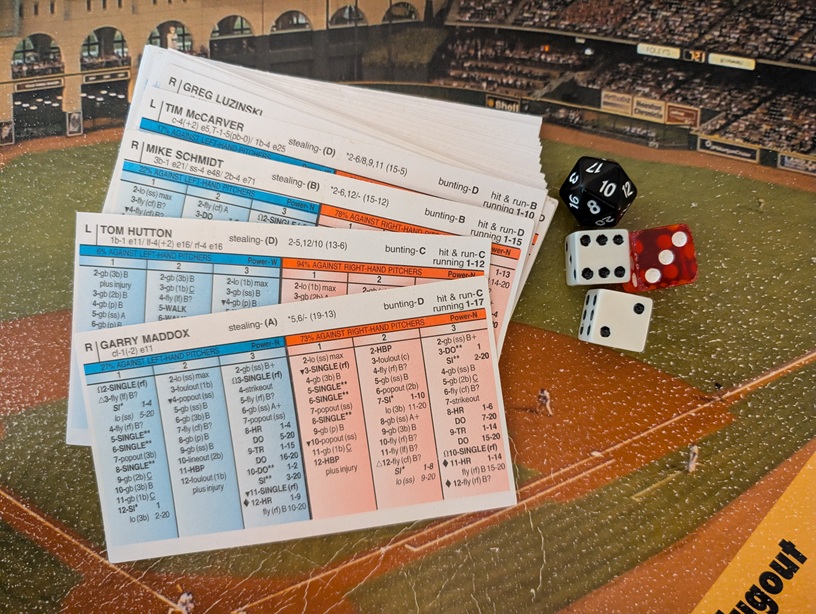
Games are played using the Strat-o-Matic® Baseball Super Advanced rules, with the modifications described here.
Adjust the baserunner's "good lead" success by the pitcher's hold rating. If a good lead is achieved, the runner must attempt to steal immediately, using the first number in the steal rating. If no good lead is achieved, runner may steal at any time using the second number. Adjust the steal rating by the catcher's throwing rating (no further adjustment based on pitcher's hold).
Hold rating:
Example: Ken Griffey is 2-5/- (16-11).
Use the rules above to determine the good lead. A runner must achieve a good lead to attempt a steal of 3rd base; use the second number in parentheses (adjusted by catcher's throwing rating) to determine a successful steal.
With the Infield In and a runner on third (and not with the bases loaded), the offensive manager can announce "Running on Contact". If NOT Running on Contact, change a result of 7 on the Groundball Result Chart (Super Advanced) to 1: batter out, runners hold.
If Running on Contact and result is 7 on the Groundball Result Chart, the Defensive Manager may elect to take the out at first (run scores). If the Defensive Manager elects to make a play at the plate, the safe range is Players Running Rating -6 + Infielder's fielding rating. On a ground ball to the pitcher, the runner is always out.
Do not apply these changes on a GB-X result.
On Fly Ball B, runner at second may attempt to advance to 3rd. Safe range is baserunner rating +/- outfielder arm rating, and:
On Fly Ball B? with runners on second and third, offense first announces if runner on third is tagging; then defense announces if the throw is going home or to third; then offense announces if the runner on second is tagging. If the throw goes home, the runner on second advances to third.
When a runner attempts to advance an extra base on a single (no stars) if the runner is safe and the roll is 1-6, the batter advances to second.
With runners on first and second, roll 20-sided die in these cases:
When gb(p) X results in a ground ball and an error:
On any throw by an outfielder with a runner attempting to advance, a roll of 1-3 is a throwing error on the outfielder. Any trailing runners advance one base. The defensive manager may concede the extra base to hold the trailing runners and prevent a possible error.
With two outs, runners advance two bases. With less than two outs, runners advance one base.
Result is a double, runner from first may attempt to score.
Roll the 20-sided die.
Pitcher Rest and Tiredness Rules: